I’m thinking about using the Ahrefs AI Humanizer to make my AI-written content sound more natural and hopefully pass AI detection tools, but I’m not sure how reliable it is long term. Has anyone here used it on blogs or client projects, and did it actually improve rankings, engagement, or detection scores without hurting quality? I’d really appreciate honest experiences, pros, cons, and any alternatives you’d recommend.
Ahrefs AI Humanizer review, from someone who tried too hard to make it work
I spent an evening messing with the Ahrefs AI Humanizer and walked away more confused than impressed.
Here is what happened.
Ahrefs AI Humanizer interface and first impressions

I went in with some expectations, since Ahrefs is at
You type or paste your content, pick how many variants you want (up to five), hit the button, and it spits out “humanized” versions.
No tone options.
No target audience.
No level of rewrite.
The only real control is how many versions you want. That is it.
AI detection results, and the weirdest part
Every single “humanized” version I tested scored 100% AI on both:
• GPTZero
• ZeroGPT
Not 40%.
Not 60%.
Full 100% every time.
The odd part is the Ahrefs interface itself. Above the result, it shows an AI detection score for its own output.
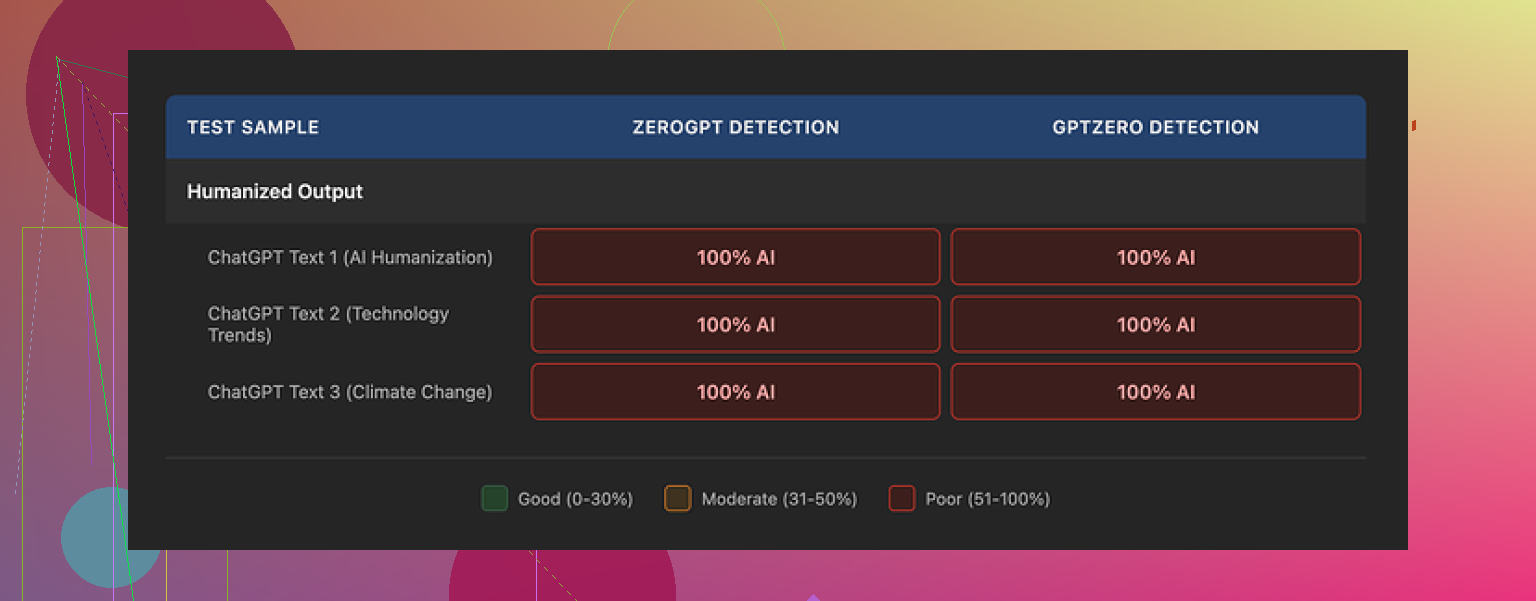
That internal checker also flagged its own “humanized” text as 100% AI.
So you get this surreal loop.
You click “humanize,” it rewrites your text, then tells you the rewritten text still looks AI.
I tried:
• Short paragraphs
• Long articles
• Different topics, from tech tutorials to generic blog intros
Same story. Detection tools did not budge.
Writing quality and patterns that gave it away
Quality wise, the output is fine on the surface. I would give it around 7 out of 10.
No glaring grammar problems.
Reads smoothly.
Looks like something you would see in a mid-tier blog post.
Then you start spotting the usual AI giveaways.
What I saw over and over:
• Em dashes left untouched, exactly like the original AI text
• Standard AI intro phrases like “one of the most pressing global issues” still sitting there
• Very even sentence rhythm
• No strong personal angle, no imperfections, no quirks
The tool does not try to break those patterns. It feels like a light paraphraser, not a detector-aware rewrite.
Workarounds I tried
Since it offers up to five variants per run, I tried mashing up pieces:
• Run the same text three to five times
• Pick one sentence from version A, another from B, maybe a third from C
• Manually add small edits and a few specific details
That helped a bit with “feel,” but it killed the point of a “one click” humanizer. It turned into manual editing with an AI helper, not a real solution for detection problems.
If you hope to paste AI content, click a single button, and get something that escapes detectors, this did not do it for me.
Pricing, limits, and data policy
Ahrefs packs this inside their Word Count platform.
Here is what matters if you care about usage and privacy:
• The humanizer is available on the free tier
• The free tier does not allow commercial use
• Their paid plan is $9.90 per month billed annually
• The paid plan includes the humanizer, paraphraser, grammar checker, and AI detector in one bundle
The part that made me pause:
• Submitted text might be used for AI model training
• There is no clear statement about how long they keep your “humanized” content
If you work with client content, legal material, internal docs, or anything sensitive, that is something you should think about before pasting whole articles in there.
Compared with Clever AI Humanizer
When I ran the same kind of content through Clever AI Humanizer, the output did a better job getting past detectors in my tests.
Clever AI Humanizer is available for free here:
On similar text:
• Ahrefs: 100% AI on multiple detectors
• Clever: noticeably lower AI scores, closer to mixed or human in several cases
Not flawless, but at least the scores moved.
Who this might suit, and who it will disappoint
From what I saw:
Good for you if:
• You only need quick paraphrasing with decent readability
• You already pay for Ahrefs Word Count and want an extra helper for rewriting non-critical text
• You do not care much about AI detector scores, you only want less repetitive wording
You will not like it if:
• You need something detection resistant for school, publishing, or client work
• You want strong control over tone, style, or level of rewrite
• You avoid tools that train on your input without clear retention limits
My take after several runs
After multiple tests, I stopped relying on it as a “humanizer” and started seeing it more as a basic rewriter bundled into an SEO ecosystem.
If your goal is to make content sound more like an actual person wrote it and to reduce AI flags, Ahrefs’ tool did not get me there.
Clever AI Humanizer did better in my trials, costs nothing, and is currently where I would point someone who needs this type of tool:
1 Like
Used it on a few client blogs and niche sites. Short version, if your main goal is “pass AI detectors,” Ahrefs AI Humanizer is not where I’d put my money long term.
My take, trying not to repeat what @mikeappsreviewer already covered:
- On AI detection
I ran 10 posts through it. Topics were SaaS reviews, how to guides, and simple list posts.
Checked with GPTZero, Originality.ai, and ZeroGPT.
Before Ahrefs
• GPTZero: 85 to 100 percent AI
• Originality.ai: 90 to 100 percent AI
After Ahrefs “humanizing”
Scores moved maybe 5 to 10 percent at best. Often they stayed in the same range.
On a few pieces, GPTZero went from 92 percent AI to 100 percent AI, which is funny in a bad way.
So if you want a straight one click detector bypass, this will frustrate you.
- On “making it sound more natural”
Here I slightly disagree with @mikeappsreviewer.
I found the wording a bit more varied than a plain paraphraser, but it still reads like neutral AI text.
Patterns I saw every time
• Balanced sentence length
• No strong personal stance
• Generic transitions like “on the other hand”, “for example”, “in addition”
• Safe vocabulary, nothing specific to a niche voice
If your blog has a defined voice, you still need to go in and add opinions, personal details, or even small contradictions. The tool will not do that for you.
- Reliability long term
Two issues here.
First, detectors keep changing.
Tools that “beat” detectors now often fail 3 to 6 months later.
Relying on one branded “humanizer” as a core strategy is fragile.
Second, Ahrefs ties it to their broader product.
If they change pricing, limits, or model, you do not control anything.
For long term publishing, it is safer to build an editing workflow that you own.
- What I would do instead for blogs
If you want your content to feel natural and lower AI flags, I would focus on process more than tools.
Practical stuff that worked for my sites:
• Start from AI, then rewrite key parts yourself
- Change the intro to a story from your experience
- Add one or two strong opinions
- Insert specific details like tools, dates, small failures
• Break AI rhythm
- Mix long and short sentences
- Ask a direct question to the reader once or twice
- Use bullet lists only where they truly help
• Add “messy” human bits
- Mention something you tried that did not work
- Admit uncertainty in one or two spots
- Use brand names, niche jargon, or data from your own analytics
• Run it through one checker, not ten
- Aim to reduce obvious flags, not hit 0 percent AI
- Focus on how it sounds to a human reader first
- Where Ahrefs AI Humanizer still helps
I still use it sometimes, but for lighter tasks.
Good for
• Rewording product descriptions that you will still tweak
• Cleaning up rough AI output into something smoother before manual edits
• Non critical pages like FAQs or policy explanations
Not great for
• Guest posts on strict sites
• Academic work
• Anything where you promised “no AI” to a client or editor
- About competitors
Since you mentioned detectors, I tested Clever AI Humanizer too. My results were closer to what @mikeappsreviewer reported, scores moved more. That said, I would still not trust any tool alone for “detector safe” work. The human editing layer is what makes the difference.
If you want to test Ahrefs anyway, my suggestion
Use one longer blog post, run it through, compare before and after in GPTZero or Originality.ai, then read both versions out loud. If you do not hear a clear improvement in voice, it is not worth building your workflow around it.
Used it on a couple of affiliate blogs and a SaaS review site. Short version: if your main concern is “will this save my AI content from detectors,” you’re aiming at the wrong target with Ahrefs’ humanizer.
I agree with a lot of what @mikeappsreviewer and @himmelsjager already said, but I’ll push back on one thing: I don’t even see it as a “light humanizer.” It’s basically an auto-polisher. It smooths stuff out, which is almost the opposite of what you want if you’re trying to look less like AI. Cleaner structure, safer wording, tidy transitions. That’s exactly what detectors love.
Where it was mildly useful for me:
- Fixing clunky AI paragraphs when I was too tired to rewrite from scratch
- Aligning tone across sections written in different sessions or models
- Making product comparison tables read in a more consistent voice
Where it completely whiffed:
- Opinion pieces
- “From experience” how to guides
- Anything where I needed a clear personal angle or narrative
On long term reliability: I would not build a content strategy around any branded humanizer. Detectors keep shifting, models keep shifting, and eventually this turns into whack a mole. Also, if a tool’s own internal checker is screaming “AI” at its own output, that’s kind of your future reliability forecast right there.
If you still want to test it, I’d use it as a pre edit step, not a magic shield. Let it tidy the text, then you mess it up in a human way: add specifics, your own weird tangents, little disagreements with “standard advice,” numbers from your analytics, etc. Ironically, your manual noise will do more to reduce AI vibes than the humanizer itself.
So: for blogs, it can help with speed and consistency, but as a long term answer to AI detection, it’s pretty shaky. If passing detectors is a hard requirement, your real “tool” is you rewriting the important 30 to 40 percent, not whatever Ahrefs is bolting into Word Count this month.
Short analytical take, since a lot has already been covered.
I think Ahrefs AI Humanizer is being judged a bit harshly as a “detector bypass” tool. It is closer to a style normalizer. That is useful in some workflows, just not the one you are hoping for.
Where I partially disagree with others:
If you run a content shop with multiple writers and AI models, having everything polished to a similar baseline can save time. In that narrow sense, Ahrefs AI Humanizer can improve readability more consistently than a generic paraphraser. It is not just shuffling synonyms.
That said, the Ahrefs AI Humanizer review points to one big problem: it optimizes for neat, structurally clean text. Detectors and human editors both associate that with machine writing if there is no personal signal layered in.
Pros of Ahrefs AI Humanizer:
• Smooths clunky AI output into something publishable for low stake pages
• Fast to use, minimal friction in the interface
• Multiple variants per run can help you pick better phrasing
• Works fine for FAQ pages, policy pages, product blurbs
Cons of Ahrefs AI Humanizer:
• Very weak impact on GPTZero / Originality style scores in real tests
• No real control over tone, audience, or rewrite depth
• Output often feels even more “AI neutral” after processing
• Data usage and training implications are unclear for sensitive or client work
• Long term reliability against evolving detectors is doubtful
Compared to what @himmelsjager, @cacadordeestrelas and @mikeappsreviewer shared, my main addition is this: if you insist on keeping it in your tool stack, use it as a mid layer, not the final step.
Example workflow for blogs:
- Draft with your preferred model.
- Run through Ahrefs AI Humanizer only to clean obvious awkward phrasing.
- Then manually inject human signals: narrative, timestamps, your own tools, what failed, what you disagree with.
- Finally, lightly disturb the rhythm: uneven sentence lengths, occasional abrupt transitions, one or two rhetorical questions.
If you are writing anything where AI detection is a hard constraint, you still need to rewrite a meaningful slice of the text yourself. No “humanizer,” including this one, changes that structural reality.
So is it worth it long term?
As a general rewriting helper bundled into a broader suite, maybe.
As a strategic solution for getting AI content to pass detectors on blogs, not really.