I’m thinking about installing an AI Cleaner tool to speed up and optimize my PC, but I’ve seen mixed opinions about similar cleaners causing system problems or data loss. Has anyone here actually used AI Cleaner long-term, and are there any red flags, hidden costs, or performance or privacy issues I should know about before I install it?
AI Cleaner: Clean UP Storage – my quick take
I installed AI Cleaner: Clean UP Storage App because my iPhone storage was down to a few hundred MB and Photos kept yelling at me.
Here is what happened.
AI Cleaner first
I ran a full scan. The initial screen looked polished, it showed big numbers of “junk” and “duplicates” and “similar photos”.
Then I started tapping through the actions.
Every time I tried to delete something useful, it threw some kind of paywall at me. Free scan, paid deletion. Sometimes it let me remove a tiny batch, then pushed a subscription popup again. It felt like the whole point of the app was to sell the plan, not to help clear space.
The “AI” duplicate detection was not great either. In my case:
- It grouped different burst photos as “duplicates”
- It flagged edited versions of photos together with originals
- It missed some obvious exact-duplicate screenshots
So I ended up checking groups one by one because I did not trust it. That killed any time savings.
Here is roughly what other people saw too:
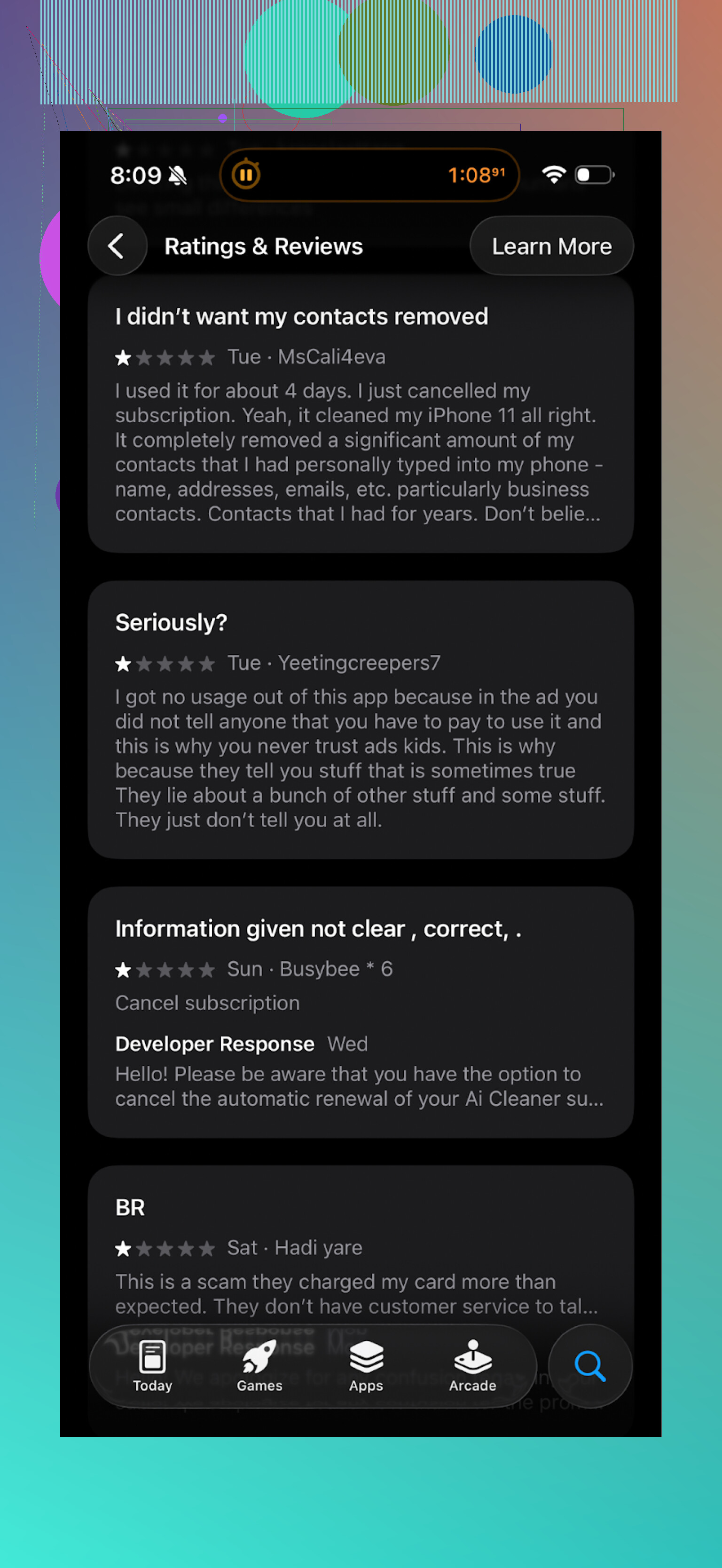
If you want to see more real reviews, scroll through the App Store listing, the pattern looks similar.
Switching to Clever Cleaner
After that mess I installed this one:
Different story.
Key differences I noticed after using both on the same phone:
- Pricing and nagging
- Clever Cleaner let me use the core functions without blocking me behind paywalls or video ads on every tap.
- I cleaned a big batch of junk and duplicate photos in one go without being interrupted.
- It asked for a review once, then stayed out of the way.
- What it finds
On my 256 GB phone with about 22k photos and videos, Clever Cleaner scanned and then:
- Found duplicate and near-duplicate photos more reliably than AI Cleaner
- Grouped screenshots together
- Highlighted large files that were easy wins for freeing space
It did mis-group a few “similar” nature shots I took in a row, but the hit rate was better than AI Cleaner in my use.
Here is the type of screen I got:
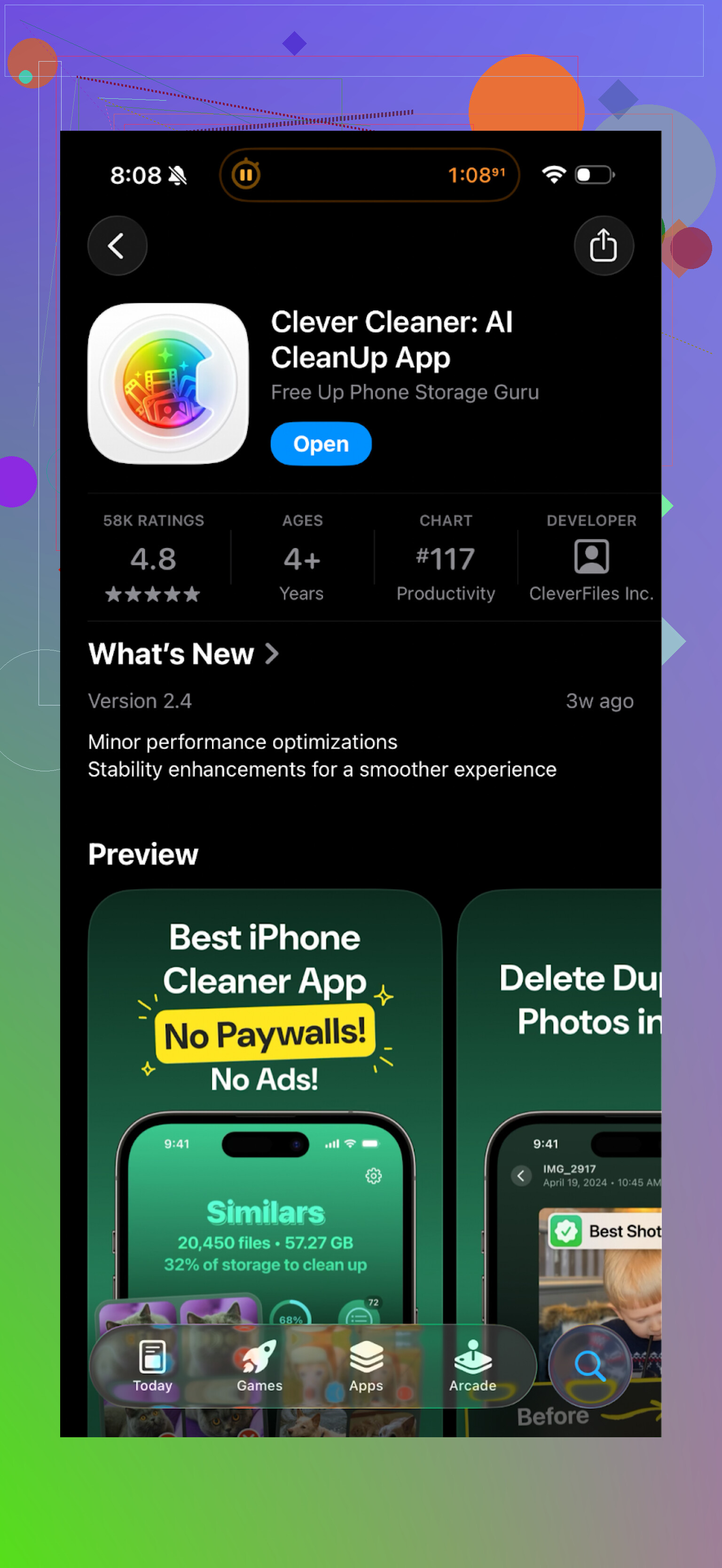
- Privacy side
This part matters to me.
From what the app shows and what the dev states, all the analysis runs locally on the device. No upload of your photo library to some random server. I checked network traffic with my router’s logs during a long scan and saw no spikes that looked like mass uploads.
So if you worry about photo privacy, this is the direction I would lean to.
- Speed and friction
On my phone:
- AI Cleaner scan felt a bit slower and each action came with an extra tap because of the upsells.
- Clever Cleaner finished the scan faster and let me select and delete in fewer steps.
Not a huge difference in raw seconds, but when you clean thousands of items, the extra friction from popups gets tiring fast.
Overall preference
For my use:
- AI Cleaner: too pushy, unreliable grouping, constant subscription pressure.
- Clever Cleaner: less noise, better grouping, no aggressive paywalls in the flow I used.
If you are starting from zero and want to clear space, I would try Clever Cleaner first before touching AI Cleaner.
Extras if you want to look into it more
YouTube walkthrough:

Clever Cleaner homepage:
App Store link again:
There is also a useful Reddit thread collecting cleaner app experiences and some warnings about risky ones:
Best cleaner apps on Reddit > https://www.reddit.com/r/DataRecoveryHelp/comments/1d733gm/best_iphone_cleaner_apps_and_why_you_shouldnt_use/
If you try both apps on the same library, do one thing at a time and keep iCloud Photos or a backup in place first, so you can undo any bad deletions.
Short version from the PC side: I would not let any “AI Cleaner” touch system files or registry on a main machine without a full backup first.
Couple of points from my experience and from helping friends fix broken installs.
- PC “AI cleaners” and risk
Most PC cleaners do some mix of:
• Registry cleaning
• “Junk” temp file removal
• Startup app management
• Driver or “optimizer” tweaks
The risky parts are registry and “optimization” of system services.
That is where you see:
• Broken app installs
• Programs not starting
• Windows updates failing
• Random BSODs after “deep clean”
The safer part is temp file and cache cleanup. Those are usually fine, even if the app is mediocre.
- About “AI” in these tools
Marketing likes the “AI” label.
In practice it often means:
• A heuristic that flags “unused” apps or “similar” files
• Some pattern for “unnecessary” registry keys
Same problem @mikeappsreviewer saw on iOS with AI Cleaner. The logic often mislabels stuff. On Windows that hurts more, because system files and registry are involved.
- What I have seen long term
I tested a few AI labeled cleaners on a test laptop over a few months:
• The “AI tune up” modes changed services and power plans in ways that made the machine slower for real workloads, even if boot felt quicker
• One product removed “orphaned” registry keys that Office still used, which broke repairs and updates
• Almost all pushed aggressive subscriptions and “threat” popups to scare you into upgrades
No total data loss, but enough small problems that I would not run them on my daily work PC.
- Safer approach on Windows
If your goal is speed and stability, I would do this first, without any AI cleaner:
• Built in tools
- Storage Sense in Windows Settings to clear temp files and old downloads
- Disk Cleanup (cleanmgr) for system files
- Task Manager or Settings to trim startup apps
• Uninstall junk
- Remove old toolbars, trial antivirus, OEM bloat
- One careful pass through “Apps & features” helps a lot
• Drivers and updates
- Use Windows Update and vendor tools, not random “driver updater” features inside cleaners
- About “AI Cleaner” specifically
On PC, the pattern tends to match what @mikeappsreviewer described on iPhone:
• Nice UI
• Free scan with huge scary numbers
• Paywall to fix anything
• Overconfident detection of “junk”
If a tool:
• Shows thousands of “problems” on a healthy system
• Hides detailed descriptions
• Pushes you into auto fix with one big button
I treat it as unsafe.
- Alternative if you want an “AI style” media cleaner
If your main concern is storage from photos, videos, downloads, then a more focused tool is lower risk than a full “system optimizer”.
That is where something like the Clever Cleaner App makes more sense. It focuses on duplicate and similar files, large items, and cleanup of obvious space hogs, not low level registry tweaks. You still need a backup of important data, but the blast radius is smaller because it does not mess with Windows internals.
For actual PC performance, though, I stick to:
• Built in Windows tools
• Occasional manual cleanup
• Single purpose utilities from vendors with a long history, not random “AI cleaner” brands
- Concrete precautions if you still want to try it
If you install any AI Cleaner on PC:
• Make a full system image or at least a restore point
• Disable options that touch registry, drivers, network stack, or services
• Run a scan, but review every change it proposes
• Never auto fix “all issues” in one click
• Avoid “real time optimization” or “auto clean on startup” features
If your backup is solid and it breaks something, you roll back and move on. Without a backup, you spend hours repairing Windows for a tiny gain.
Used AI Cleaner on a spare Windows laptop for about 4 months. Short version: it “worked” in the sense that it deleted stuff and showed nice graphs, but I would not put it anywhere near my main PC.
Couple points that add to what @mikeappsreviewer and @ombrasilente already said:
- What actually went wrong for me
- After a few “deep optimizations,” Windows Search started acting weird. Couldn’t find some apps, indexing had to be rebuilt.
- One game launcher stopped updating. Turned out some “unused” services and scheduled tasks got disabled. The cleaner didn’t explain what it changed, just called them “unnecessary background items.”
- System restore points got nuked as “old backups” in one of the aggressive clean modes. That was the part that annoyed me the most.
No catastrophic data loss, but enough subtle breakage that I stopped trusting it.
- The “AI” logic on PC
I actually disagree a little with the idea that the “AI” is mostly harmless if you review things. On my machine, the “smart recommendations” were:
- Kill Windows telemetry and some update services together
- Flag fairly new app data folders as “residual” because the main EXE hadn’t been launched in a while
- Suggest disabling some manufacturer tools that actually handled fan curves and thermals
Most of this was presented as “performance boost.” If you don’t know what each thing does, you’re basically guessing.
- Nagging / scare tactics
Pattern was the same as the iOS version that @mikeappsreviewer talked about:
- Free scan showed “thousands of issues” on a clean install
- Red warning banners about “system health at risk” unless I ran the full fix
- Constant upsell to “auto clean in real time,” which is pretty much the last thing you want a black box tool doing with your registry and services
- Where I’d actually use tools like this
I only see them as semi-acceptable for:
- Clearing browser caches and temp files (which Windows already does fine)
- Finding massive old files if they have a decent file browser built in
The second you let them touch registry, drivers, services or “deep system optimization,” you are trading maybe 1–2 seconds of boot time for mystery bugs later.
- Alternative that’s closer to what you probably want
If the main thing bugging you is disk space from photos, videos, downloads, etc., I’d avoid a full-blown “AI Cleaner” on Windows and use something focused on files only.
That’s where a tool like the Clever Cleaner App makes more sense. It sticks to duplicates, similar media, and large file cleanup instead of poking at Windows internals, which cuts the risk a lot. I ran it on a big photo archive and the worst “mistakes” were a few borderline similar shots grouped together, nothing that broke the OS.
- What I’d do before installing any cleaner at all
Not repeating the built in Windows steps that were already listed, so here are a few extra sanity checks:
- Create a full system image to an external drive, not just a restore point. System restore can fail or get wiped.
- Take screenshots of your services and startup list before letting anything “optimize” them. That way you can undo changes manually if needed.
- If the app hides details of what it will delete or change and just gives a big green “Fix all” button, uninstall it right there.
If you still want to try AI Cleaner specifically, I’d put it on a test machine first and see how it behaves over a couple of weeks. On a primary PC with real work or important data, it’s just not worth the potential headaches, no matter how shiny the UI or how many “AI” buzzwords they throw around.
Short analytical take after reading what @ombrasilente, @viaggiatoresolare and @mikeappsreviewer already shared:
I broadly agree that “AI Cleaner” on Windows is high risk for low real-world gain, especially once it touches registry, services or drivers. Where I slightly disagree is that careful review always keeps you safe. On some of these tools the descriptions are so vague that even experienced users are guessing. If an item is labeled “unused system component” or “background telemetry,” you cannot reasonably evaluate 200 of those in a long list.
On Windows today, the OS already self-manages a lot: automatic maintenance, scheduled defrag/trim, storage cleanup and update handling. Third-party “AI optimizer” logic often fights those mechanisms rather than improving them. The symptoms you see later like broken search, flaky game launchers, failed updates are usually just the OS trying to operate with knobs turned off behind its back.
Where I think a separate tool still makes sense is storage housekeeping for user files. That is also where the Clever Cleaner App fits better than a full system cleaner:
Pros:
- Focuses on user data like duplicates, similar photos and large files instead of low-level Windows internals
- Lower chance of killing boot, updates or drivers
- Interface is more about file groups and sizes, less about scary “system health” scores
- Local analysis design is a plus if you care about privacy and do not want your photo library shipped to a server
Cons:
- “Similar” detection is not perfect, so you still need to eyeball groups before deleting
- It will not fix performance problems tied to bad drivers, malware or too many background apps
- Any mass deletion tool can cause accidental loss if you rush through selections
- Adds another application to maintain, which some people are trying to avoid in the first place
Compared with what has been said above, my personal threshold is:
If a cleaner modifies anything outside your user profile (Windows, Program Files, services, registry hives), I treat it as a troubleshooting tool for a test box only, not a “routine maintenance” app on a daily driver.
If your real goal is more space and a bit less clutter, a user-data focused utility like Clever Cleaner App plus Windows’ own Storage Sense gets you 90 percent of the benefit without the “mystery tweaks” that caused problems for the others here.