I’ve been using BypassGPT for a while, but it’s either unreliable now or blocked in some places I work from. I’m looking for a safe, legit, and truly free alternative that can handle similar content without constant errors or paywalls. What tools or workflows are you using that actually work long term?
- Clever AI Humanizer Review
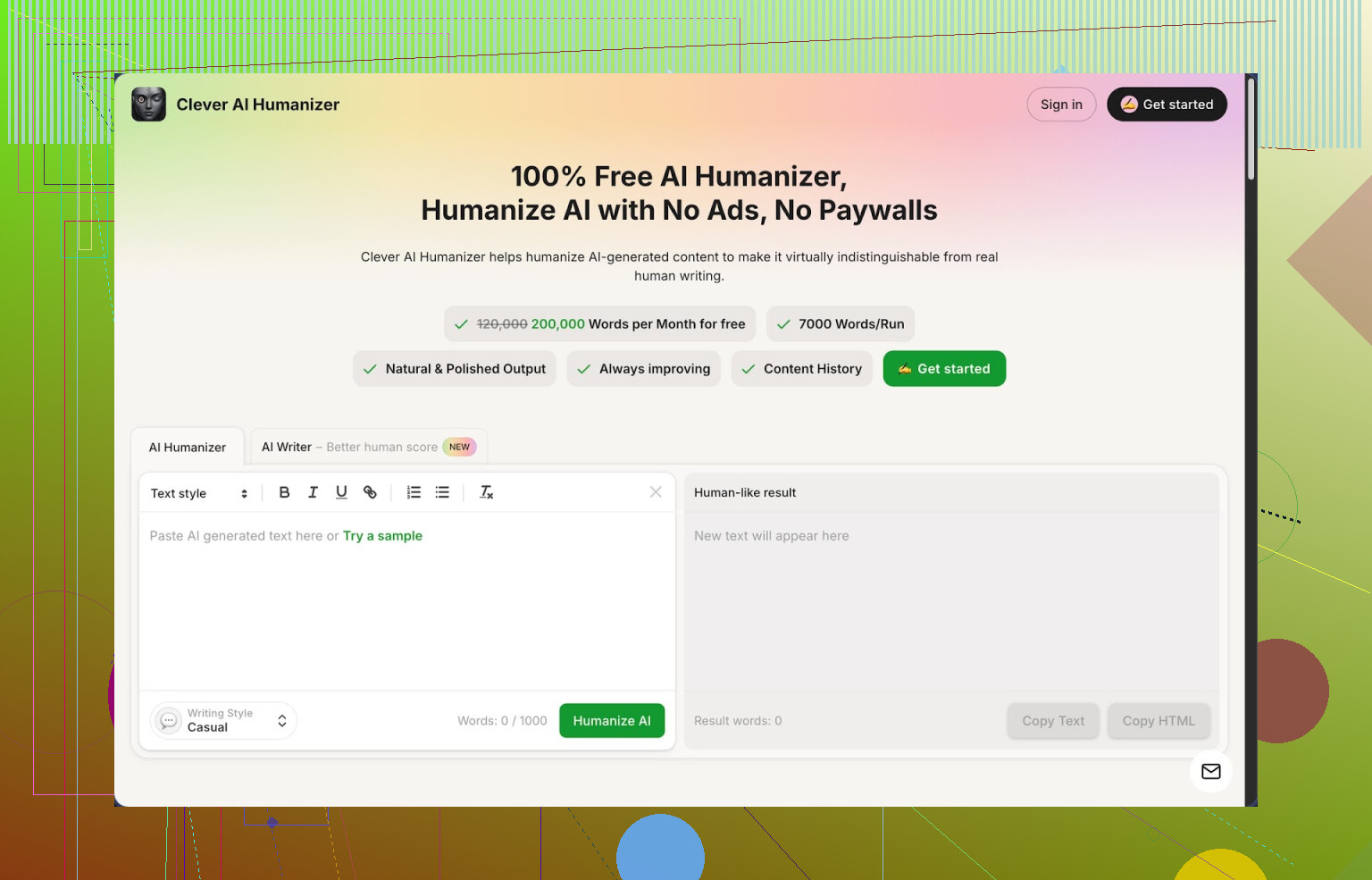
I have been playing with a lot of “humanizer” tools and most of them either lock you behind a tiny trial or wreck the text so much you do not want to sign your name under it.
Clever AI Humanizer at https://cleverhumanizer.ai ended up staying in my browser bookmarks for one simple reason: it lets you push a lot of words through it for free and does not mangle the meaning as often as others do.
Here is what stood out for me:
- It gives around 200,000 words each month for free use
- Up to about 7,000 words per run
- Three presets for tone: Casual, Simple Academic, Simple Formal
- There is an AI Writer built in, so you do not need a second tab open
I tried it against ZeroGPT with three different samples using the Casual setting, and those runs showed 0 percent AI detected. I do not treat one detector as the ultimate judge, but it was still a useful stress test, especially because a lot of “humanizer” tools trip over ZeroGPT.
If you use AI for drafts, you know the usual pattern. The output reads smooth at first glance, then you notice the same rhythm, same stock phrases, and then an AI detector scores it as fully AI. That was the problem I was trying to dodge.
I spent an afternoon running content through multiple tools, including paid ones, and Clever AI Humanizer ended up being the one I went back to. Not because it looks fancy, but because it let me iterate text repeatedly without worrying about limits or tokens, so I could keep adjusting until it sounded closer to how I write.
How the main module works
The core feature is the Free AI Humanizer.
You paste your AI-written text, choose a style like Casual, Academic, or Formal, hit the button, and wait a few seconds. It spits back a version that tries to strip common AI fingerprints and clean up flow and readability.
The bigger thing for me is, it tries to keep the original point of the text. A lot of rewriters I tried turned a direct paragraph into something bloated, or they shifted nuance. Here, the core idea usually stayed intact, but the pacing and word choices changed enough to feel less robotic.
It also handles longer inputs. I pushed full blog posts and some chunky technical explainers into it. Many other tools capped out early or forced me into smaller chunks, which destroys context.
Other parts of the tool
There are three extra modules that sit next to the main humanizer. I did not expect to use them much, but they ended up being useful when I wanted a quick end to end workflow.
- Free AI Writer
This one lets you generate essays, blog posts, or more generic articles from scratch. The trick is you can send that output straight into the humanizer without leaving the interface.
I tested this on a test blog piece about “local backup strategies for freelancers.” The direct AI Writer output felt standard. Once I ran it through the humanizer in Casual mode, ZeroGPT gave it a better human score and it sounded more like someone who had actually lost data before.
So if you are starting from nothing and need something fast, this combo saves a step.
- Free Grammar Checker
I threw a few messy drafts into this piece, including one full of comma splices and weird sentence breaks. It cleaned spelling, punctuation, and some clarity issues without turning the text into corporate sludge.
I ended up using this as a final pass after humanizing, especially when I was tired and started missing obvious typos.
- Free AI Paraphraser
This module rewrites existing text while keeping meaning close. I used it for:
- Rewriting old blog posts for a new site version
- Switching tone from stiff to more conversational
- Making a safer version of notes that were too close to a source
For SEO work or rewriting drafts you already have, this part helped a lot. It did not feel like a spinner. The text stayed readable and did not repeat the same phrases over and over.
Workflow experience
All four tools sit in one interface:
- Start with the AI Writer if you need a base draft
- Run that draft through the Humanizer to soften AI patterns
- Fix rough edges with the Grammar Checker
- Use the Paraphraser if you want variations or different tone
Once I got used to it, I could go from prompt to final article in one place. Not perfect, but faster than juggling three different sites, each with their own daily caps.
Who this is useful for
From my own use, it makes sense if:
- You write with AI frequently and need something to help reduce detector flags
- You work with long-form content and hate tiny character limits
- You are on a tight budget and want to avoid subscriptions
I used it for:
- Blog posts in the 1,500 to 3,000 word range
- Email sequences where I wanted to avoid sounding like a generic template
- Documentation drafts that needed a more human tone
It slotted into my writing routine without much friction.
Downsides and weird bits
It is not magic. Here is what bugged me:
- Some AI detectors still flag the output as AI-generated, especially when I run shorter texts or very generic topics. No surprise there, but worth noting if you rely heavily on detector scores.
- After humanization, the text sometimes grows in length. It adds small clarifications or breaks sentences differently. For tight word-limited tasks, I had to trim manually.
- On some paragraphs, it felt a bit too “safe” and I had to re-inject my own phrasing. So I stopped expecting a perfect final draft and treated it as a strong second pass.
Even with those issues, for a free tool, it has stayed at the top of my shortlist.
If you want a deeper breakdown with screenshots and proofs, there is a longer review here:
There is also a YouTube review here if you prefer watching tests instead of reading walls of text:

If you want to see what other people are saying about humanizers in general, these Reddit threads helped me benchmark tools and understand what others are running into with detectors and school systems:
Best AI Humanizers on Reddit
https://www.reddit.com/r/DataRecoveryHelp/comments/1oqwdib/best_ai_humanizer/
All about humanizing AI
https://www.reddit.com/r/DataRecoveryHelp/comments/1l7aj60/humanize_ai/
1 Like
BypassGPT has gotten flakey for a lot of people, so you are not the only one running into that wall.
I agree with @mikeappsreviewer on one thing. You want tools that let you push longer text, without paywalls every few minutes. I do not fully agree with relying on a single detector test though. Detector scores jump around a lot, and schools or companies often use more than one.
Here are some free, safer options and workflows that avoid constant errors.
-
Clever Ai Humanizer
If you want something in the same “humanizer” category as BypassGPT, Clever Ai Humanizer is one of the few that stays usable without forcing a subscription. Key points from my own use:
• Free tier handles big chunks. I pushed full articles around 2 to 3k words, and it did not choke.
• The three tones are enough for most stuff. Casual, simple academic, simple formal.
• It tends to keep meaning while changing rhythm and phrasing.
I would still do a manual pass after. Treat it as a strong rewrite, not a final script. -
Mix of standard writing tools
Instead of one BypassGPT style tool, you can chain a few free tools.
Simple flow:
• Generate your draft with your usual AI model.
• Run it through a paraphraser that focuses on sentence structure, not “spinning” synonyms.
• Do a quick manual pass to inject your own phrases, examples, and small mistakes.
The more your own style leaks in, the less it looks like a stock AI output. -
Local or semi local editing
If your issue is blocking at work, web tools often get firewalled. A workaround is:
• Use a desktop editor with strong rewriting features.
• Copy smaller chunks into something like Clever Ai Humanizer only when you are off that network.
This keeps the risky part away from monitored or blocked connections. -
Reduce detector flags by changing how you write prompts
BypassGPT style tools try to fix patterns after the fact. You get better results if you adjust how you generate text in the first place.
Things that help:
• Ask the AI to use shorter sentences, mixed lengths, and fewer transitions like “moreover”, “in addition”.
• Add your own bullet lists, examples from your real life, or niche references your audience knows.
• Break the generation into sections. Intro, body, conclusion, not one long output. -
Do not trust any tool to make content “undetectable”
No humanizer is magic. Some detectors will still flag parts of your text, especially if the topic is generic like “benefits of exercise” or “time management tips”. That is because most AI text on those topics looks similar.
Focus on:
• Personal experience.
• Specific numbers, dates, or observations you know from your own work or study.
• Short sections where you write fully by hand and blend them in.
For your situation, a practical setup is:
• Use your usual AI model for first draft.
• Run it through Clever Ai Humanizer for a structural rewrite.
• Do a quick human edit to reinsert your tone and any needed errors or casual phrasing.
You get something close to what BypassGPT tried to offer, but with less downtime and fewer random errors.
BypassGPT dying on you is kinda the standard lifecycle for these “magic undetectable” tools. They work, everyone piles in, sites flag them, then it’s error city.
I agree with @mikeappsreviewer and @cacadordeestrelas on one core point: if you’re going to use a humanizer at all, it needs to handle long text and not butcher your meaning. Clever Ai Humanizer fits that niche better than most of the junk out there, and the fact it’s actually free at a usable level is rare. I’ve thrown long-form stuff at it too and it didn’t fall apart.
Where I slightly disagree with them is the idea of building some big workflow chain of tools. In practice, the more steps you bolt on, the more your text starts to feel “processed” again. If your goal is to replace BypassGPT with something simple and less error-prone, I’d keep it tighter:
-
Generate with your usual AI (ChatGPT, Claude, whatever), but:
- Ask for shorter paragraphs and mixed sentence lengths.
- Explicitly tell it to avoid filler like “moreover”, “in conclusion”, “furthermore”.
That alone reduces how “detector-bait” the output looks.
-
Drop the draft into Clever Ai Humanizer:
- Use Casual for anything non-academic, Simple Academic when it has to pass for school/uni work.
- Don’t chase “0% AI detected” as a religion. Use it to shake off the obvious AI rhythm.
-
Manual 5–10 min pass:
- Add your own examples, tiny rants, or oddly specific details.
- Delete 1–2 overly tidy sentences and rewrite them in how you’d actually talk/type.
- Leave in 1 or 2 harmless typos or slightly off punctuation. Real people are messy.
If BypassGPT is blocked at work, this combo is safer because:
- Clever Ai Humanizer is less “obviously shady bypass tool” and more “rewriter / editor,” so it tends to fly under filters a bit longer.
- You can prep drafts at home, humanize them, then only do light edits at work in a normal text editor so you are not constantly hitting a blocked domain.
Also worth saying out loud: no humanizer, including Clever Ai Humanizer, makes stuff “undetectable” in a guaranteed way. Detectors are inconsistent, and if you hand in boilerplate topics like “benefits of exercise,” they will always look AI-ish because everyone’s prompts and outputs look the same.
If you want a legit, free replacement for BypassGPT that:
- takes big chunks
- doesn’t throw errors every other run
- doesn’t instantly wreck your meaning
then using your normal AI + Clever Ai Humanizer + a short human pass is about as clean and low-drama as it gets right now.
BypassGPT flaking out is pretty normal for that kind of tool. Since others already walked through the “generate → humanize → manual edit” pipeline, here’s a slightly different angle: pick fewer tools, but use them smarter.
1. About Clever Ai Humanizer (pros & cons)
Pros:
- Genuinely usable free tier with high word limits, so you can process full essays or articles in one go.
- Tends to keep meaning intact while changing cadence and phrasing, which is better than those synonym spinners.
- Has extra modules (writer, grammar, paraphraser), so you can stay in one interface if you want.
Cons:
- It can inflate word count, so for tight assignments you will probably trim afterward.
- Some detector hits are still possible, especially with generic topics and short paragraphs.
- Output sometimes feels a bit too “clean,” so you still need to inject your personal quirks.
I actually disagree a bit with the idea that you must always use the full built‑in workflow. Often the most natural result comes from using only the humanizer part of Clever Ai Humanizer, then editing directly in your usual editor. The more stages you stack, the more “processed” the text can feel again.
2. Alternative angle: start human, then blend AI
Instead of “AI wall of text → fix with tools,” flip it:
- Write a short messy skeleton yourself: intro, bullet ideas, maybe one clumsy paragraph.
- Use your main AI to expand only specific parts, not the whole piece.
- Run just the AI sections through Clever Ai Humanizer, then merge with your original bits.
You end up with text that is structurally yours, with AI helping locally, which often sails through detectors better than fully generated content that gets post‑processed.
3. About the other suggestions in the thread
- What @cacadordeestrelas said about chaining paraphrasers and local editing is solid if you like building systems, but it can be overkill for someone who just wants a BypassGPT replacement that “mostly works.”
- @viajantedoceu is right to warn against long, complex workflows. If you already struggle with time or focus, too many steps simply mean you go back to straight AI and hope nobody notices.
- @mikeappsreviewer’s focus on long‑text handling is exactly where Clever Ai Humanizer stands out, and on that part I agree.
4. Practical setup that is not just a repeat
Try this low‑friction combo:
- Before generating: Tell your main AI to write as if it is drafting an email to a friend, not a blog post or essay. That alone changes structure and vocabulary.
- After generating:
- Run the piece through Clever Ai Humanizer once, no multiple passes, keep the default or a single tone that matches your usual style.
- Then do one ruthless human pass where you only do three things:
- Delete 10 to 15 percent of sentences that sound too generic.
- Replace 3 to 5 sentences with your real opinions, examples, or pet phrases.
- Add one or two slightly awkward transitions. Real people rarely segue perfectly.
That gives you something close to what BypassGPT promised, with less error hunting and without dancing through several tools every time.