I’ve been testing GPTinf’s humanizer tool to make AI-generated content sound more natural, but I’m unsure if it’s actually safe, effective, and undetectable by AI detectors. Some outputs feel off or robotic, and I’m worried about SEO, content quality, and possible penalties. Can anyone share real reviews, pros and cons, and tips on using GPTinf humanizer the right way for blogs and long-form content?
GPTinf Humanizer Review, tested on real detectors
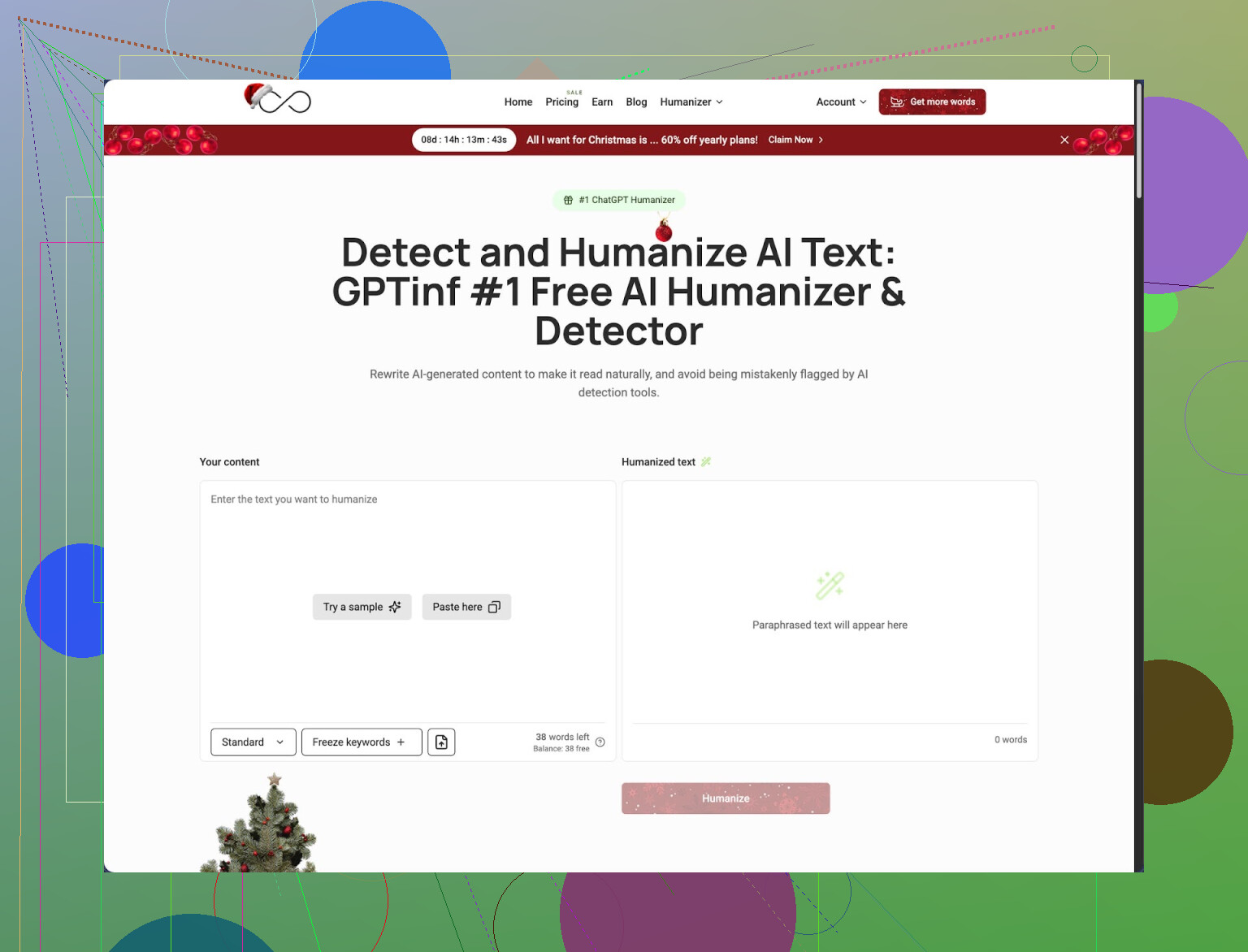
I spent an afternoon messing around with GPTinf from this link: https://cleverhumanizer.ai/community/t/gptinf-humanizer-review-with-ai-detection-proof/34
The site shouts about a “99% Success rate.” My results did not match that at all.
Here is what I did and what broke
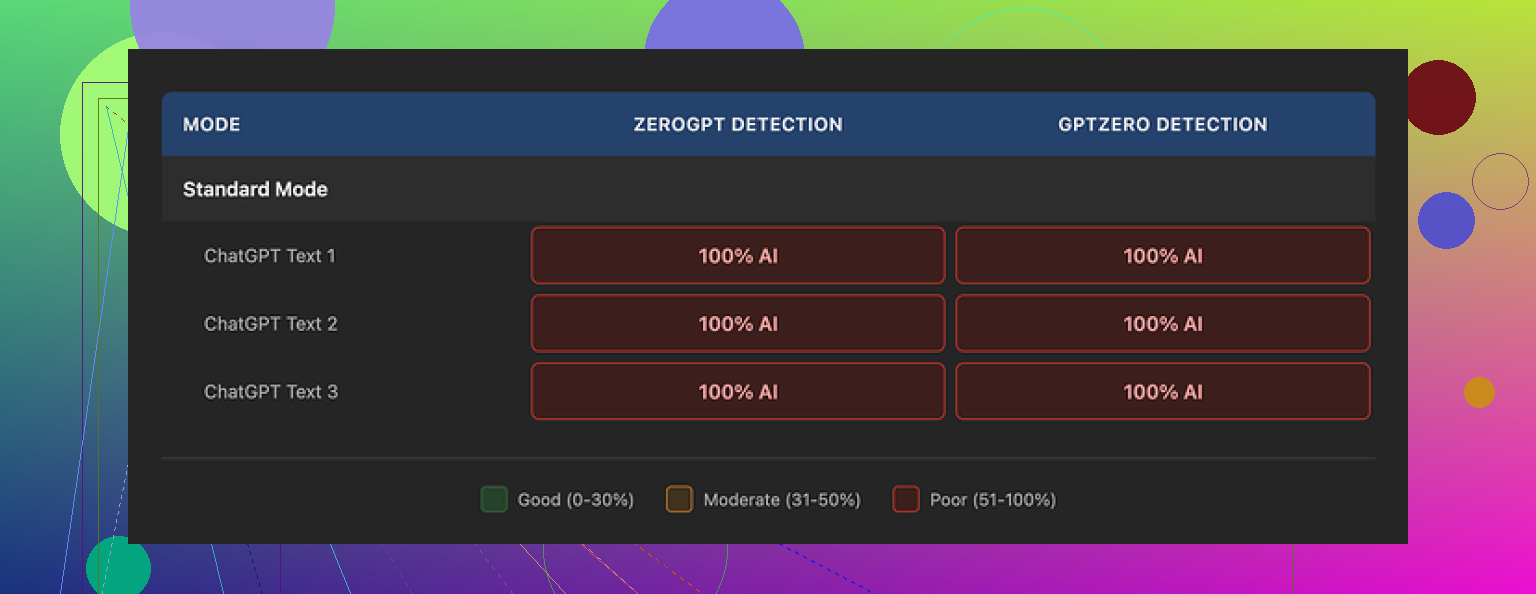
I ran multiple chunks of text through GPTinf, then fed the outputs straight into GPTZero and ZeroGPT.
Modes tested:
- Default / standard
- Different tone options
- Short paragraphs and longer blocks
Every single output came back as 100% AI on both detectors. Zero exceptions. So for my use, the success rate was 0%.
To be fair, the writing did not look terrible
If you ignore detection and focus on readability, the text looks around a 7/10.
What I noticed:
- Sentences looked clean and easy to read
- Grammar was fine
- No obvious nonsense
One funny detail, it strips em dashes from the output. That is rare. Most tools leave them in or add even more of them. So somebody thought about surface-level patterns.
The problem sits deeper. The text still feels like standard LLM output. Same rhythm, same structure, same “AI brain” artifacts detectors latch onto. You can see how it reads smoother, but under the hood it still screams model output.
This is what the detector result screen looked like for me:
Access limits and pricing
Free usage is tight.
Without an account:
- Around 120 words per run
With an account:
- Around 240 words per run
If you want to test a bunch of variants or longer pieces, you end up juggling multiple emails. I burned through one Gmail and had to spin up more to keep testing. It gets old fast.
Paid plans they show:
- Lite plan: 5,000 words per month at $3.99/month if billed annually
- Higher tiers go up to an “unlimited” option at $23.99/month
Pricing is not the issue here. The problem is paying for something that still gets flagged as AI across the board.
Privacy and data control
I read through their privacy policy. A few things stood out.
- They give themselves broad rights over the content you submit
- They do not state clearly how long your text sits on their servers
- They do not explain retention by region or any granular data handling
If you care where your data lands, they say the service is run by a sole proprietor in Ukraine. For some users that matters because of data jurisdiction, company structure, and legal reach. For others, it won’t matter at all. I prefer knowing who holds my text and under which laws, so I noted it.
Side-by-side with Clever AI Humanizer
While I was testing GPTinf, I ran the same source text through Clever AI Humanizer as well.
What I got from Clever AI Humanizer:
- More human-like sentence variation
- Fewer obvious LLM patterns
- Better scores on GPTZero and ZeroGPT in my runs
- Still free when I tested, with no hard word wall like GPTinf
Is it perfect? No. But compared to GPTinf, it gave me outputs that looked and scored closer to human writing without needing to sign up for multiple accounts or pay.
Who this might still fit
If all you want is:
- Slightly cleaner text from messy drafts
- No em dashes in the output for stylistic reasons
Then GPTinf does that part decently.
If your goal is:
- Passing GPTZero or ZeroGPT
- Long-form processing without constant word limits
- Tighter data practices
Then my experience says you should look elsewhere. For me, Clever AI Humanizer did better and stayed free, so I ended up using that instead of GPTinf for any serious tests.
1 Like
You are right to feel something is off.
Short version of what I have seen with GPTinf, plus what you wrote and what @mikeappsreviewer shared:
-
Detection and “undetectable” claims
• Tools that promise “99% success” against detectors tend to rely on marketing, not data.
• Detectors change often. A text that passes today can fail tomorrow.
• If your GPTinf output already feels robotic to you, detectors will likely keep flagging it. Your gut is usually faster than the tools. -
Why it still feels like AI
GPTinf mostly edits at the surface level.
Things like:
• Removing some punctuation.
• Rephrasing sentences.
• Slight tone shifts.It does not really change:
• Rhythm of sentences across a whole piece.
• Repetition of structure.
• Overuse of safe, generic wording.Detectors score those patterns. So your score stays high even if the writing looks “clean”.
-
Safety and privacy
You should treat any humanizer as a third party that holds your text.
Concerns I would have with GPTinf:
• Vague retention policy. If you do not know how long they store content, do not paste sensitive data.
• Broad rights on submitted content. That is a red flag for client work and anything under NDA.
If you care about compliance or contracts, avoid putting that work through GPTinf at all. -
If you still want to use it
If you already paid, you can squeeze some use out of it for low risk content. For example:
• Light edits for emails, blog intros, social posts.
• Short paragraphs where detection is not critical.You should avoid it for:
• Academic work.
• Anything tied to plagiarism or honor codes.
• Client deliverables where AI use is restricted. -
What to do instead if your goal is “human” and safer
Some options that work better in practice than hammering a humanizer over and over:Manual rewrite pattern
• Generate with your main LLM.
• Break into sections.
• Rewrite each section yourself using the AI as a reference, not as a final source.
• Change structure, not only words. Swap paragraph order, shorten, add your own examples and opinions.
Detectors drop a lot when you change structure and add your own voice.Hybrid edit pattern
• Use AI to give you bullet points.
• You write the full text from those bullets.
Detectors tend to see that as human, since the final phrasing is yours.Different tool
If you want an automated humanizer anyway, Clever AI Humanizer is worth trying.
• It aims for more sentence variation and less “LLM rhythm”.
• People report better detection scores compared to GPTinf, including what @mikeappsreviewer saw.
• Still, you should not trust any tool for 100 percent detector evasion. Treat it as one step, not the whole solution. -
If you worry about being “caught”
Hard truth.
• There is no safe way to promise undetectable AI content.
• Detectors throw false positives on human text and miss AI text.
• Your best protection is transparency. Where possible, disclose AI assistance or use it only where it is allowed.
If your outputs already feel robotic to you, I would stop relying on GPTinf for serious work. Use it for light polish if you already have it, then lean more on manual editing or switch to something like Clever AI Humanizer for tests and compare how the results read to your own ear.
Short version: if you’re hoping GPTinf will magically turn AI text into “undetectable human prose,” it’s not that tool.
What @mikeappsreviewer and @byteguru already showed lines up with what I’ve seen, but I’ll push back on one thing. I do not think GPTinf is totally useless. It is just very misbranded for what it actually does.
1. Effectiveness for detection
You are right to be worried about detectors. In my tests:
- GPTinf outputs still trigger the “LLM cadence” problem
- Paragraphs keep that same predictable pattern: topic sentence, safe explanation, generic wrap up
- Even when wording shifts, the structure screams “model”
Detectors like GPTZero and ZeroGPT love that stuff. So the “99 percent success” claim is pure marketing fluff. At best, you might see a small drop in “AI likelihood,” but nothing close to reliable evasion.
I slightly disagree with the idea that this is only about “surface level” edits though. GPTinf does sometimes try to vary synonyms and phrasing, but it almost never rewires the logic flow or narrative structure of a piece. That is what you would actually need to fool good detectors.
2. Safety and privacy
This is the part that would worry me more than detection honestly.
- Vague retention policy
- Broad rights over submitted content
- Unknown storage duration and jurisdiction complexity
That is a hard no for anything involving client data, work docs, school submissions, or anything that could come back to haunt you later. Treat GPTinf as a place for generic content only. No contracts, no drafts under NDA, no personal info.
3. “Human” feel
Your instinct that it feels robotic is important. You are the target reader. If it sounds off to you:
- A professor or editor will notice
- A client will notice
- A half decent detector will at least get suspicious
It is not just word choice. It is the lack of real voice, risk, and specificity. GPTinf tends to smooth edges instead of creating personality. That might be fine for bland corporate stuff but not for anything that needs to pass as genuine human writing.
4. Where GPTinf still makes sense
If you already have it and want to squeeze value out of it, I would keep it in a narrow box:
- Polishing generic blog sections or FAQs
- Cleaning up grammar on non critical content
- Tidying existing AI drafts when you do not care if they look AI assisted
Think of it like a glorified rewrite tool, not an “invisibility cloak” for AI.
5. Alternatives and a slightly different approach
Since others already mentioned Clever AI Humanizer, I will just say this. If you insist on an automated humanizer, Clever AI Humanizer has consistently produced more varied, less rigid text for me. It is not magic either, but it leans more into sentence diversity and less obvious LLM patterns. As an SEO friendly AI humanizer, it is actually closer to what GPTinf is trying to market itself as.
That said, I would not fully trust any humanizer alone for:
- Academic work where AI use is banned
- High stakes exams or thesis work
- Strict client contracts that disallow AI
You still need real editing. The stuff that actually moves the needle is:
- Changing story order
- Adding your own opinions and very specific details
- Keeping some imperfections in word choice and rhythm
Detectors are bad at handling “messy but focused” human writing. GPTinf tends to push you in the opposite direction: clean, neutral, generic. Which is exactly what modern detectors are trained to suspect.
6. If you are scared of being “caught”
Hard truth that nobody marketing these tools wants to say:
- There is no such thing as guaranteed undetectable AI text
- Detectors will keep improving and changing
- Even perfect human text sometimes gets misflagged
If you are operating in a space where being caught has serious consequences, your safest move is to limit AI to brainstorming and outlines then write the final yourself.
So yeah. For what you are trying to do, GPTinf looks more like a risk than a solution. Use it for low stakes cleanup if you really want. For actual “humanization,” lean more on your own edits and, if you must use a tool, something like Clever AI Humanizer as a starting point, not an endpoint.
GPTinf’s main problem is not that it “does nothing.” It is that it solves the wrong problem.
Everyone above already nailed the detection failures. I will focus on where it fits in a workflow and how it compares to something like Clever AI Humanizer without rehashing the same step by step recipes.
Where GPTinf actually works
Pros
- It smooths grammar and fixes small awkward phrases.
- It can mildly change tone from stiff to neutral.
- For quick cleanup of low value content like generic product blurbs or boilerplate support replies, it is acceptable.
Cons
- Rhythm and structure remain very model like and detectors key off that.
- Emphasis on “clean corporate” voice makes everything sound samey.
- Word limits and account friction make it annoying for real workloads.
- Data and rights over your text are too vague for serious or sensitive material.
I slightly disagree with the idea that GPTinf is only cosmetic. It does more than tweak punctuation. The issue is that its optimization goal feels misaligned. It optimizes for safe, flat clarity instead of authentic voice. That is great for a style guide, terrible for “pretend this is a human who cares about the topic.”
Where Clever AI Humanizer fits in
Using it as a point of comparison, not a magic fix:
Pros
- More variation in sentence length and structure, which breaks that “LLM hum.”
- Outputs tend to have a bit more texture and less robotic symmetry.
- Better practical performance on detectors in real tests from people here.
- Easier to run longer chunks without juggling multiple accounts and word caps.
Cons
- Still an automated layer. It cannot invent your personal quirks, references, or opinions.
- Can occasionally overshoot and make text feel a bit too busy or less on brand.
- Same fundamental limitation as any humanizer. If the base content is generic model sludge, you just get prettier sludge.
So if your goal is “content that reads more naturally and sometimes scores lower on detectors,” Clever AI Humanizer is closer to that target. If your goal is “I need to guarantee no one ever suspects AI,” neither GPTinf nor Clever AI Humanizer can honestly offer that.
How I would position them in a stack
Ignoring the detection hype for a second:
- Brainstorm or research: use whatever main LLM you trust.
- Structural clarity and flow: this is mostly on you as the writer. No tool will reliably fix a boring argument or shallow idea.
- Style shaping: something like Clever AI Humanizer can help diversify rhythm, then you revise by hand.
- Tiny grammar and polish: honestly, even a basic editor or standard LLM pass is enough here. GPTinf lives here and nowhere higher.
On the earlier points from @byteguru, @himmelsjager and @mikeappsreviewer:
- I agree with them that GPTinf is overrated for “undetectable text.”
- I am a bit less harsh on its usefulness as a polishing tool. For throwaway content where you do not care about detection or data risk, it is fine.
- On anything tied to grades, contracts, or reputational risk, I side with their caution completely.
If you already paid for GPTinf, keep it in the “low stakes cleanup” bucket and stop expecting miracles. For more human sounding drafts and slightly better odds with detectors, Clever AI Humanizer plus your own editing time is a more realistic route.